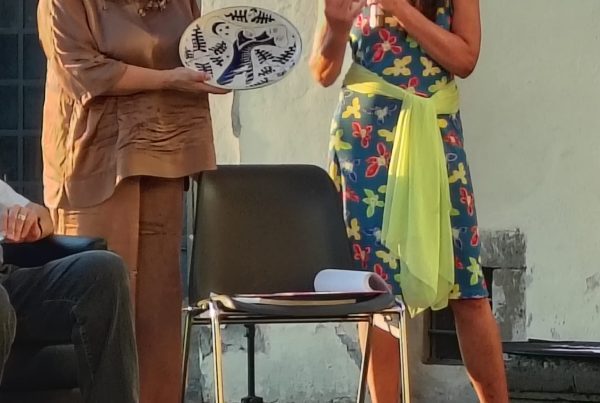
The “Pope” — specifically Alexander IV, whom I placed among the Arcana of Faul — inevitably opens a window onto the figure of Saint Rose. This Pope managed to turn the opening of a common “pit” that held the saint’s remains into a “crowd” in delirium for this slight figure. As you can see, every arcanum leads us to another, establishing a continuous dialogue full of stimuli that pushes us to open those closed boxes — as if they were tombs — allowing us to escape the narrowness of our own conceptions and discover the immensity of what lies beyond us. As symbolised by Arcanum No. XX, “Judgement”, the angel opening the tomb represents a spiritual rebirth; today, being both in Lent and in quarantine, we must live our resurrection, our Easter, with a different awareness. We must build a scaffolding for our soul, rising to the highest part of the sky, pushing ourselves to the very limit of our vision, placing ourselves at the same height as the saint. This queen of the heavens, of the ideal — “The Empress” — governs creation, and it is She who establishes the connection between the “builders” and the “Great Architect of the Universe”. This has often translated into works of art such as the “Macchina di Santa Rosa”, destined to remain “sacred”. Alexander IV’s body has never been found and remains a mystery shrouded in darkness. The same pontiff — the only one in history to remain “secret” — by opening the Saint’s tomb “revealed” to everyone, as only an arcanum can, the beauty of this “Rose”, bringing light into our hearts and illuminating history, and not only that of our city. A happy coincidence within the discord.
As in the arcana, so in life: nothing is absolute — high and low, light and shadow, joy and despair, falling and rising again. Just as the Saint’s heart was found intact, so too the love we carry for Her is “age-old”, unceasingly beating and untouched by time. Why is this “Rose” so loved, especially by the young? Because, as tarot symbolism has it, Arcanum No. III, “The Empress”, speaks of the energy of adolescence, releasing life force and representing the sheer lack of experience that comes with youth. This “joyful fervour” that the young people show, gathering the day before the 3rd of September in the streets and squares as if waiting for a concert, is something that astonishes and fills us with pride. We are used to seeing such crowding at stadiums, not for a Saint — yet our challenge, made of fashions, trends, likes, dislikes, rationality and irrationality, still manages to move our young people. She is a modern figure; after all, She is used to crowds. She began by rousing the masses to stand against Emperor Frederick II, so much so that when she asked to be admitted among the Poor Clares she was refused, because her “Empress” spirit, her warrior’s bearing, clashed with religious principles. This Sovereign radiating light represents “creative intelligence”, the mother of the shapes ideas take — the same burst of creativity and expressiveness that led the designers of the Macchina di Santa Rosa to give form to ideas in which we always see a “Rose”, Queen of the heavens, occupying the highest and most sublime place of the ideal. My personal pairing for Arcanum No. III is, of course, the “Young Rose”, who, like a true Empress equipped with shield and sceptre — symbols of masculine power — watches over her faithful from above, ready now as then to keep vigil over the crowds, today frightened in their homes but tomorrow back in the streets to admire, as every year, a true power of the soul. At times these days we feel like spectators of our own lives. Next September, in our city — never so ready to welcome so many people — we will once again feel that happy, familiar sensation of being directors, screenwriters and leading actors in the most beautiful story and spectacle staged for centuries. Just as in every life cycle, a “Rose” today, more than ever, represents our spring, continuing to bloom as it has since 1258, so that humanity may still come to gather its buds. The decorative motif in sapphire blue of a heart set within another heart is a tribute to the Saint. The same design was placed on a large jug set beside the Saint’s body on the initiative of “centesimiAmo”. The emptiness of the great vase, recalling the miracle of the healed jug, is ready to be filled by the generosity and the great heart of the faithful.