The symbolism of this card is the right balance, exactly what we most need in this moment of relentless instability. This card alludes to the Wheel of Fortune, and also represents becoming, fluctuating over the dark movements of chaotic life. Some have also seen analogies between this card and the spoked rose windows of cathedrals, and others have seen the wheel of torture, which on a psychological level is what pretty much all of us are living through today. On this great wheel, still in balance, there are 4 different figures, from different social situations and of different ages, clinging to it.
Its movement can lead to involution or evolution, since the wheel can always turn the other way. Since the human mind is always the author of all its actions, and we, centred on our own lives, are the starting point for change, letting ourselves “turn” will bring to life a new impulse that will start a new cycle. The wheel invites us to reflect on the inevitable alternation of successes and failures, joys and sorrows, rises and falls. It steers us towards change, which could be positive or negative; the only certainty is that we must move towards accepting constant change.
Between one change and the next, let us allow ourselves, as the wheel does, to accept change with humility and patience, because only when reality stops turning on itself will our consciousness be born. To wait for the right moment to act usefully, we must keep ourselves outside the current that drags the crowd along. We must wait for the opportunity to intervene usefully. Let us likewise carry on, following the “advice” of Arcanum X, waiting for the signal that commands action to start again, to get moving once more; we must benefit from the alternation of fortune.
In my personal pairing of the Arcana of Faul, for the Wheel I included “the Empire and the Papacy”. The image is inspired by a 13th-century miniature from the “Carmina Burana”, where Frederick II, placed at the centre of the wheel, represents the eternal contest for power that marked Viterbo’s internal struggles. The wheel has turned, at times in favour of one, at times of the other. The towers placed at the top of the wheel, with the typical Guelph and Ghibelline battlements, highlight the precarious balance between the two powers.
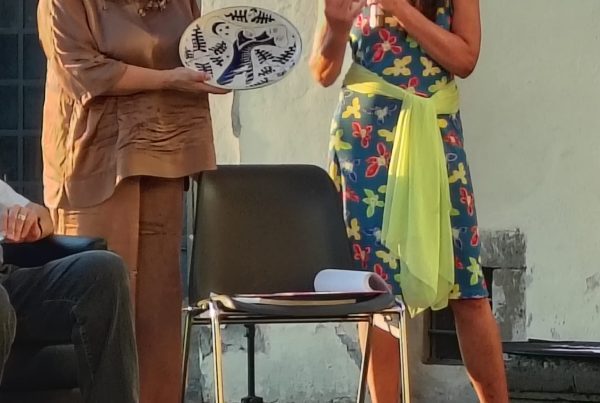
The earliest depiction of the Wheel, as we find it on many tarot decks, dates to the late 12th century, in a manuscript from a cloister in Strasbourg, where the rising figure bears the words “I shall reign”, the one at the top “I reign”, the descending one “I have reigned”, and the one at the bottom “I am without a reign”. This, today, is our position: let us start believing in the meaning of the wheel of fortune, which will bring us to the only possible position of stability on a wheel, namely the top. I dedicate to all of us this plate, itself “circular”, inspired by Arcanum X.