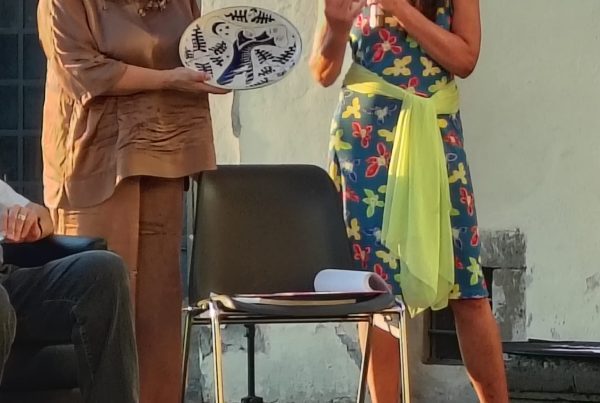
A little over a month after the presentation of the TUSCIA INCANTATA project, yesterday, 1 September 2020, in the medieval heart of the City of Viterbo, on Via San Pellegrino, in front of Cinzia Chiulli’s workshop – Percorsi Artistici. An “on the road” press conference by the Tuscia Incantata association to present a game, “The Game”, featuring cards designed by Cinzia Chiulli herself.
On site, to talk about the cards that will go on sale from early December, were some members of Tuscia Incantata: city councillor Chiara Frontini, Fabio Cavini, Benedetta di Carlo and Elia Caprera. Cinzia Chiulli was also present.
“Identity cards – said Frontini – linked to the city’s history. Alfio and the Caterinaccia will represent Viterbo. In this phase, and until the end of the year – she continued – we are working on the component of awareness. The residents of the villages of the enchanted Tuscia must be aware that they live in a land rich in beauty and with a strong dreamlike, evocative character. Establishing the Tuscia Incantata naming is essential to build solid promotional foundations. In this sense, this further piece of phase zero will help promote and make known the identity figures of Viterbo and the villages of the enchanted Tuscia, while having fun and socializing.”
The areas that are part of Tuscia Incantata are: Viterbo, Vitorchiano, Bagnaia, Graffignano, Sipicciano, Sant’Angelo, Roccalvecce, Celleno, and Civita di Bagnoregio.
“A little over a month after the launch of the project – added Fabio Cavini, president of the Tuscia Incantata promoting committee – and after the success of the song by Elia Caprera and Mammo Rapo dedicated to the villages that make up the itinerary, here is another milestone in building the identity connected to the common thread of enchantment and magic.”
The rules. “It’s a card game – explains Benedetta Di Carlo, vice president of the promoting committee – with simple but effective rules, made up of 28 cards. It is played with a minimum of 2 players and a maximum of 8. The card with the highest score beats the one with the lowest score.”
The cards are divided into three types: the poets, the vendors and the townsfolk. “The poets – continues Di Carlo – are the mythological figures of the villages, those who over the decades have become etched into the community’s history. For Viterbo, for example, there will be Alfio and the Caterinaccia, for Celleno there’s Sette, for Graffignano Giuseppe Carabei known as Peppe, for Sipicciano Perelli Alfiero known as Boscaiolo.”
“Each character on the cards – points out Elia Caprera, a member of the promoting team – has its own score. At the end of each hand, whoever has the higher score wins. Each winner of a hand earns a letter that spells out the word Tuscia. The goal is therefore to win 6 hands, in order to spell out the word Tuscia. If playing with a large number of players, it’s possible to decide that the winner of the game is whoever reaches a set score, choosing symbolic numbers that represent important dates for the various villages. For Viterbo, the score is 70, because in 1270 the roof of the popes’ palace was removed on the occasion of the first conclave in history.”
The game cards have not yet been revealed. “Starting from 7 September – concludes Cinzia Chiulli, the artist and designer of the cards – a card will be revealed every week, until the deck is complete and ready for the Christmas season. Covid permitting, we will gather in the villages of the enchanted Tuscia to play together over the holidays, building community and rediscovering the key figures of popular tradition.”